
Introduction to Describing Wetlands in the Field
- Start Date: June 15, 2026
- End Date: June 17, 2026
- Time: 8:30am - 4:30pm Pacific time
- City: Revelstoke BC
- Venue: Okanagan College: 1401 1 St W, Revelstoke, BC V0E 2S0; and various field sites
- Save the date! Email office@cmiae.org to be notified when registration opens
Course Description
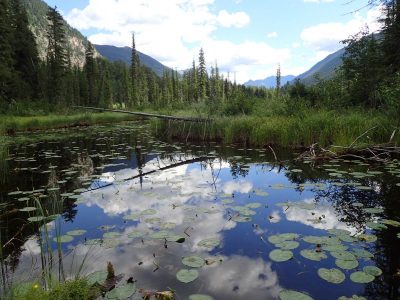 This course will introduce students to the basics of wetlands and help to increase wetland literacy in BC. Students will learn to describe vegetation, soil, and water properties relevant to wetlands; which helps in eventual classification, delineation, and functional assessments (those topics not covered in depth within this course).
Students will learn consistent field techniques of describing wetland properties and will discuss how collecting good field data can better inform wetland management practices relating to conservation, resource management, and ecosystem stewardship in BC.
After taking this course, students should be able to confidently identify and describe wetlands in BC; collect consistent vegetation, soil, and water data using standardized field techniques, and navigate key wetland field resources and forms. This will provide students with a strong foundation to build on in other courses on classification, delineation, and functional/conditional assessments.
General course outline
Day 1
The course will begin in the classroom where students have the opportunity to meet with one another and the instructor team. Focus will be on defining what a wetland is, their primary properties, preparing for field work, and thinking about field site selection.
The afternoon will be spent in the field practicing procedures for observing landscape context, site selection, and describing wetlands. Participants will learn to describe wetland properties in the field such as:
- Vegetation – strata, species identification, canopy cover (%), height, life form, dominance, hydrophytic rankings;
- Soil – horizons, depth, type, texture, colour, hydric signs, Von Post, redoximorphic features, saturation, organic and mineral soil properties;
- Water – hydrogeomorphic position, indicators, water chemistry, depth, inflows/outflows.
Other field data collection topics will include field data sheets, photo taking, drones, and tips for daily QA/QC.
Day 2 & 3
In the next two field days, we will continue to practice the field techniques in a variety of wetland types.
The field component includes 3-4 field site visits around the Revelstoke area to gain familiarity with a variety of wetland types and practice describing wetland characteristics using a variety of common field forms and relevant guidebooks. This course emphasizes both field-based observation skills and understanding how field data connects to management decisions.
Note: This course is scheduled closesly to two other courses that might interest you!
Field Soil Description & Classification, in Revelstoke June 10-12, 2026.
Amphibian Identification and Survey Techniques. This hybrid course has a field day scheduled in Revelstoke on June 18, 2026
Our Instructors
This course has a fantastic teaching team with two lead instructors who are supported by an additional team of highly knowledgeable mentor instructors.The instruction team has yet to be finalized in light of budgeting constraints with the province, but we are working hard to finalize details. See the last course listing here for a very close example of what to expect.
Who should take this course?
This course is designed for anyone wanting to better understand wetlands, people conducting wetland assessments, doing environmental consulting work, or reviewing wetland data collected by others. It will interest people working in resource management, conservation, government agencies, and others involved in wetland-related projects. It is well suited for biologists, agrologists, foresters, geoscientists, students and other environmental professionals and land managers needing to learn more about recognizing and describing wetlands. All are welcome.
Prior experience in ecosystem classification, plant ID, and soils would be a benefit, but not necessary.
Preparation and what to bring
Publications
An email with additional resources will be sent prior to the course. In the interim, please review the online PDF version of Wetlands of BC.
Field equipment
Each participant must have:
- Sturdy hiking shoes (for uneven terrain and shoveling)
- Clean rubber boots and waders
- Notebook
- Clipboard
- Mobile device or tablet to view additional field guides
- Pack or field vest to carry gear
- Water bottle (at least 1L, bagged lunches do not come with water)
- Packed lunch if you haven’t ordered the bagged lunches upon registration
- NOTE: All field gear should be cleaned and disinfected prior to the first site, and between sites. Instructors will bring disinfectant to use between sites.
It would be nice if participants have:
- Hard copy LMH 25
- Plant identification guides such as:
- Plants of the Southern Interior
- Wetland Plants of British Columbia, BCWF
- Hand lens
- Munsell soils colour charts
- Soil knife
- Vehicle for carpool: Please indicate in your registration form if you have space to take passengers in your vehicle, but can be solidified at the end of the classroom session.
- First aid kit
- Truck or hand radio with RR stations programed
Registration
Registration for this course includes catered breaks for the classroom session, coffee/tea on each field morning, and an option to add a bagged lunches for all three days of the course. Lunches and all catering supplied by La Baguette.
*CMI memberships may be purchased upon registration – read more about CMI membership here.
CMI members $550*
Non-members $605
Registration opening a bit later in the new year – email office@cmiae.org to be notified when registration opens.
NOTE: Once registration fills, you will be welcome to join our cancellation list for the course. Anyone on this list will have the chance of filling registration cancellations as well as being the first to be notified when we open up registration for next season’s course. Please email office@cmiae.org to be placed on the list.
Where to stay?
We have numerous accommodation options that offer discounts to CMI registrants:
Basecamp Revelstoke: various locations and room rates
- Discount code of 15% via the online booking tool using the promo code “CMI”
- Basecamp Resort: Just outside of town towards Revelstoke dam. About a 15min drive to the School District 19 (SD19) admin building where this course starts each day
- Basecamp Suites: A brand new build downtown Revelstoke, about a 10min walk or 5min drive to the SD19 admin building
- Northwinds Hotel: A newly acquired hotel in the Farwell area of town, about a 25min walk to the SD19 admin building. Marketed as having affordable rates. (Recommended – 2min walk from classroom and affordable.)
Thank you!
A big thank you to our event partners: BC Wildlife Federation and BC Ministry Water, Land and Resource Stewardship.